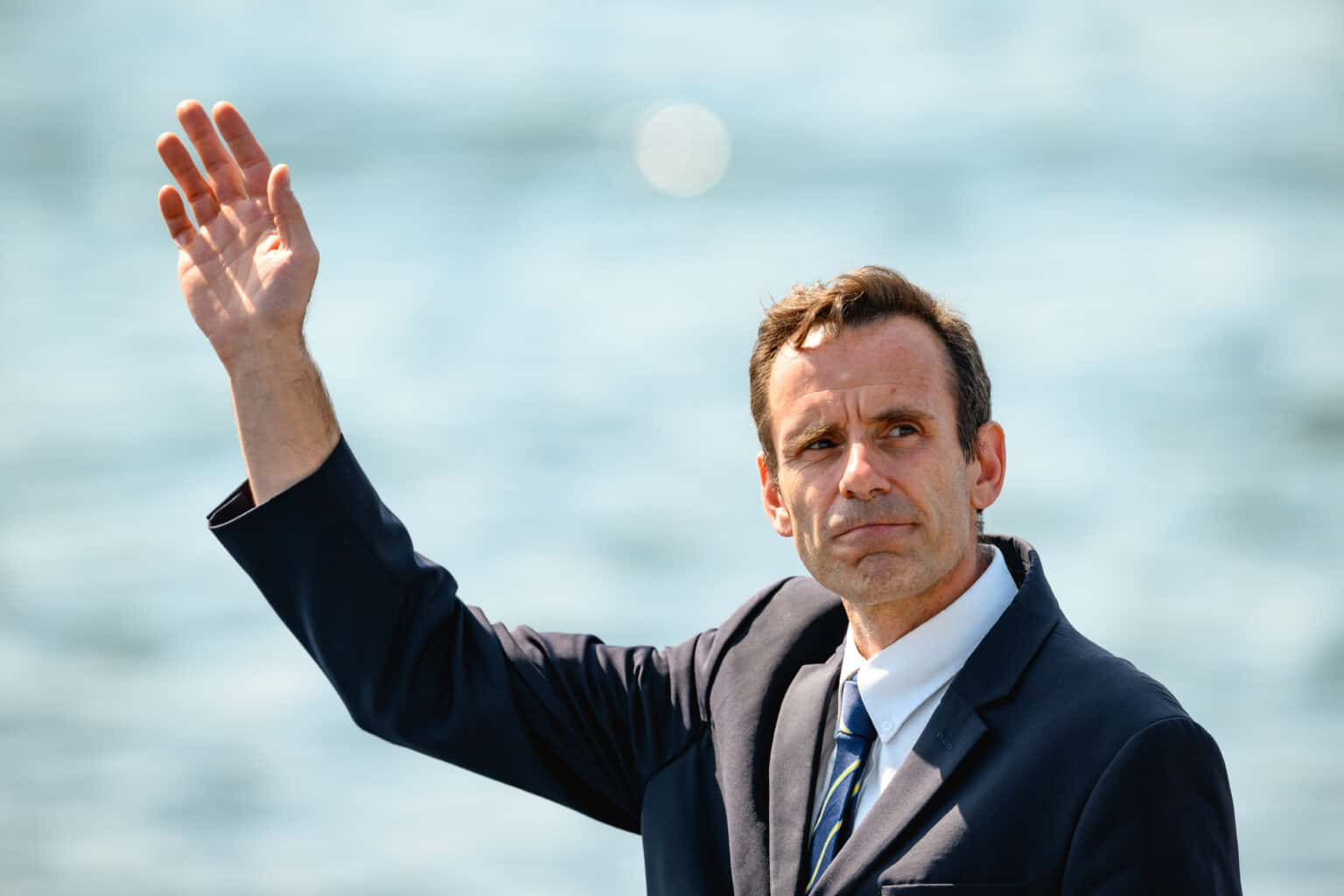
Photo: World Rowing.
Jean-Christophe Rolland has been president of World Rowing for twelve years. Re-elected in 2025 for a fourth and final term, the Frenchman intends to put rowing on the right track for the future. He speaks to Francs Jeux in a two-part interview.
You were recently in Shanghai. Why was it important to be there?
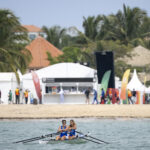
We've just launched a new event, a new concept. It was important, for our partners, to be present for the first World Rowing Shanghai Sprints. We're in a completely different environment, on a river right in the heart of an iconic city, with an extraordinary view. Rowing usually takes place on bodies of water further and further from the city center, but here we're going right into the heart of the city and among the people. This concept aims to promote our sport: by going out into the city center and connecting with people, it's a fantastic showcase.
Could this format be adapted for other cities? For example, Paris, along the Seine?
For now, we have an exclusive five-year agreement with Shanghai. We're going to develop this product. We'd already tested it; we held a France-England match on the Seine, based on a sprint concept, a few years ago. There have also been similar events in Saint Petersburg. We're here to increase our visibility and give athletes the opportunity to practice their sport in a completely different context, with spectators, in the heart of the city. In the sporting world, we need to be more visible. Our sport needs to find concepts that generate this visibility, this media appeal.
Shanghai is also where you were re-elected a year ago. You have three years left in your term. What do you hope to accomplish in that time?
The context is quite challenging. The world of sport is ultra-competitive, there are more and more sports, and people have access to so many things. How do we survive in this world? It's a major challenge for sports with a history. Even if that history is very rich, it doesn't guarantee our survival in the future. The challenge is to continue growing our sport, adapting it, and maintaining a position within the Olympic Movement that allows us to be included in the Games program and secures a future, so that rowing remains a major sport within the Olympic Movement. We can't just wait; we have to fight every day. I will continue the development process we've begun, until the end of my term, to ensure a smooth transition to the future and that rowing remains firmly established in the Olympic world, despite all the challenges.
This term will be marked by the Los Angeles 2028 Games, the first for coastal rowing. What will this bring to the Olympic program?
We're bringing a discipline that makes sense in today's world. It will reach a wider, perhaps less experienced, audience. We'll add a touch of diversity with a physical, technical, and slightly more fun sport, full of uncertainty and dynamism. Within the context of Los Angeles 2028, which is focused on the ocean and the beach, we fit perfectly into this concept. Beach sprint is a discipline in its own right within rowing, but with a completely different format. For us, it's a way to broaden our audience. We have access to countries that aren't very receptive to traditional rowing. I'm thinking of all the Caribbean islands, all the countries with coastlines. Coastal rowing is much more accessible to many countries.
There is a more "wild" side to sea rowing compared to traditional rowing, which is more formal, where everyone stays in their lane.
That's it, it's a completely different concept. We're still rowing, but with an environment a bit more suited to today's expectations. There's an element of uncertainty, it demands slightly different skills: being able to feel, read the waves, the force of the water… It gives us fantastic images. The course on the beach adds intensity. We have fantastic races with the finish line run on the sand.
Do your indicators show a rise in the discipline?
The sport is booming. We'll have 53 countries at the World Championships in China, more than 220 teams—it's really taking off. Its inclusion in the Olympic program has boosted this development. We've launched a new concept, the Beach Series, with two events initially next year, in Turkey and China. We're going to progress; the potential is enormous. We can see the enthusiasm, the growth, the progress.
Your term has also been marked by the rise of connected rowing. Is this a key driver for the future of your sport?
What we call indoor rowing, or connected rowing, is a fantastic opportunity to broaden the base of people connected to rowing. Some purists will say it's not necessarily rowing, which I can understand because there's no water. That said, for me, the goal is to connect as many people as possible to our sport, to make those who row on a machine feel connected to it. There's no internal cannibalization; our disciplines are complementary and support each other. The audience, the population, is different.
We have enormous potential if we look at society's challenges in getting young people to be physically active. The ergometer is a fantastic solution for well-being, for physical activity, and potentially for competition. That's what we're emphasizing. Rowing is admirably well-positioned in this context. We have a machine that allows us to connect with the other side of the world. We have a purely virtual World Championship, which opens up tremendous possibilities. If we look back at my manifesto from when I was first campaigning, we see the development of rowing around these three disciplines. Each has a different history and potential, but each is complementary. I am optimistic about the future of rowing, despite the difficulties, the societal challenges, and the competition in the world of sports.