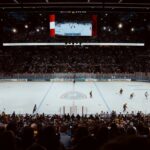
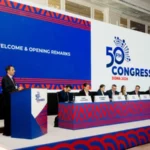
Who would've believed that ? Announced as a bid without history, built in concrete and ticking all the boxes, the Salt Lake City project for the 2034 Winter Games sparked protests during the second day of the 142nd IOC session, Wednesday July 24 at the Palais of the Paris Congresses. The Utah representatives had little to do with it. But they were shaken by several members of the body for being representatives of the United States.
Certainly, the envoys from Salt Lake City and Utah, including Governor Spencer Cox, left the session with what they had come to Paris for: the Winter Games in 2034, thirty-two years after a first edition in 2002. The candidacy obtained 83 votes out of the 89 valid, for six votes against and six abstentions. The host city contract was signed by the Americans, then countersigned by the IOC. It's in the bag. Like France, the United States will host the Olympic Games twice, six years apart.
But the presentation of the Salt Lake City-Utah 2034 delegation, with its question-and-answer sequence, announced as a simple exercise in style, was not a pleasure for the Americans. In question, the conflict between WADA and the American anti-doping agency (USADA) on the affair of Chinese swimmers not suspended despite 23 positive cases.
In the audience, several IOC members took the opportunity to criticize the United States, their attacks on WADA and their desire to use the Rodchenkov law in a matter unrelated to them and their athletes. Thomas Bach was moved, going so far as to confide to the Utah delegation: “ I'm sorry to you, and to us, that this issue has been raised now."
John Coates, for his part, invited to speak to clarify the subject, explained to the audience that the host city contract could be terminated in the event that “ WADA's supreme authority in the fight against doping was not fully respected ". Clearly, Salt Lake City would lose the Winter Games if the Americans persisted in wanting to resolve the entire planet's doping cases themselves.
The Utah delegation admitted this at a press conference, a few hours after the vote: it had prepared to have to respond to criticism from members of the body on the issue of doping. “ This problem is not directly ours, but it is that of our country, suggested Fraser Bullock, the chairman of the bid committee. We will need to ensure that everyone who comes to Salt Lake City can do so safely. » Understand, without the risk of finding yourself in an FBI interrogation room or summoned before a parliamentary committee.
Fraser Bullock explained it: the Salt Lake City-Utah 2034 team had anticipated the storm and sent a letter to Thomas Bach, before the Paris session, where they assured in writing that they recognized WADA's full authority to the fight and the anti-doping program. Spencer Cox, for his part, promised to work, between now and the 2034 Winter Games, to play conciliator by inviting everyone around the table to put an end to the conflict.
All smiles despite a spoiled party, the governor was able to get back to the basics, at a press conference: the 2034 Winter Games. With 100% of the sites already existing, the American team has already taken shelter risks of delays and the pitfalls of rising costs. “ The question is no longer, as for the Winter Games in 2002, what we should do, because everything is already done, assured Spencer Cox. It is now, today, about knowing what we want to do. » Nice formula. And a joyful prospect.