By Ed Hula (1)
Russia's flag may never fly at the Olympics again.
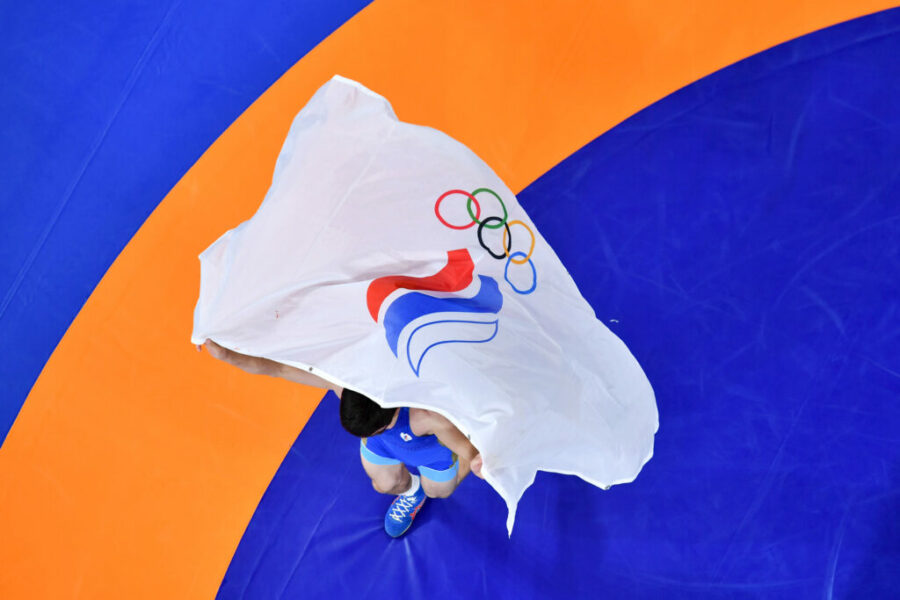
It has already been six years since the Russian flag was banned at the 2016 Rio de Janeiro Games due to a massive state doping program involving Russian winter and summer sports athletes.
Today, the prospect of a longer-term rupture seems increasingly real, as Russia's attack on Ukraine continues for a second year. Paris 2024 will probably be the third consecutive edition of the Summer Games without a recognized Russian team: neither flag nor anthem for the gold medalists. Russian athletes could compete under the guise of neutrality, but it remains unclear how they would be chosen.
Even if the Russian offensive ended overnight, would the Moscow regime have time to make amends? Probably not. Demanding accountability from Ukraine and its allies would impose conditions on Russia that will take decades to meet.
Calculating the scale and cost of repairs could be the most complicated exercise of the 21st century. They will number in the billions. The war crimes accusations and subsequent trials, like the reconstruction, will also last for years, constantly reminding us of the agonies suffered.
Among the many casualties of this war is the Olympic Games.
Last February, ministers from more than thirty European nations informed the IOC that some of them might not participate in the Paris 2024 Games, rather than making concessions on Russian participation. Ukrainian President Volodymyr Zelenskyy has taken the lead in rejecting the IOC's attempts to include Russians in the next Games. He warned: Ukraine will stay at home. She won't come to Paris.
The IOC and its president, Thomas Bach, will need all the sports diplomacy they can muster next year. Their main concern: to quell boycott threats from governments, athletes or sports federations. A lot will depend on the situation next February, especially if the shootings persist.
The United States could prove to be a major player, particularly if Congress rejects the IOC's decisions on Russian participation. Such a stance could force the U.S. Olympic and Paralympic Committee to join Ukraine in a possible boycott.
Imagine the chaos if Russia's allies also threatened to boycott the Games in solidarity with the Kremlin.
Another important test for the IOC will come at the end of the year, when the United Nations approves the Olympic Truce to be observed for the duration of the Paris 2024 Games. Noble as it is, the notion of an Olympic Truce has been made laughable by Russia itself. As the Beijing Winter Olympics drew to a close last year, Russia – one of 190 member nations to support the Olympic truce – launched its offensive in Ukraine.
With this attack, Russia continued its habit of violating the Olympic truce. Already at the end of the 2014 Winter Olympics, President Vladimir Putin shamelessly unleashed his forces to seize the Crimean peninsula.
Until now, nothing has filtered through to the IOC headquarters in Lausanne on any alternative strategy to be deployed for the Olympic truce. It is usually proposed by the host country of the next Games, in this case France.
In itself, this is reassuring for those who appreciate the symbolism of this diplomatic gesture. French President Emmanuel Macron is at the forefront of European resistance to the Russian assault. He would be an enthusiastic truce activist. At the same time, he is one of those for whom Russia's repeated contempt for the truce would not be lost.
It remains to be seen whether Vladimir Putin will have the courage to ask his diplomats to add Russia as a signatory to the 2024 Olympic truce.
As the Sochi 2014 and Beijing 2022 Winter Games showed, it would not be surprising if the Russian president approved a ceasefire during the Paris 2024 Games. But, as then, what Putin's secret plans would hide the curtain of Russian support for an Olympic truce?
Fool me once, shame on you. Fool me twice, shame on me.
Fool me three times?
Macron and other voices, like the IOC president, will have to answer this question when the General Assembly meets in September.
This grim scenario does not bode well for Russia's place at the Paris Olympics or any other event. Italy will follow with a Winter Games in 2026, likely with Russia still in the sin basket. Then there will be Los Angeles in 2028, where the absence of Russia seems predestined by history.
The last time Los Angeles hosted the Olympics, in 1984, thirteen Eastern Bloc countries joined what was then the USSR in boycotting the Games, in retaliation for the 1980 Moscow Games boycott by United States. If the parade of athletes at SoFi Stadium in 2028 takes place without Russia, the Games will be the fourth summer without an official Russian delegation.
Whether it's a boycott or continued IOC sanctions, Russia's Olympic exile, like the war it started in Ukraine, appears to have no end. An outcome favorable to Russia, to the detriment of Ukraine, would certainly be greeted with dismay around the world. But, conversely, an IOC sanction could result in a permanent ban on the Russian Federation celebrating peace and sport. Despite its frustration, the IOC will leave reconciliation to future generations.
(1) This article was originally published on the site Ed Hula Communications