The curtain fell on Sunday March 13 on the Beijing 2022 Paralympic Winter Games. Lit on Friday March 4, the flame was extinguished at the Bird's Nest in the Chinese capital, during a closing ceremony marked by the presence of Chinese President Xi Jinping.
Started against a backdrop of conflict in Ukraine, in the absence of the Russian and Belarusian delegations, the Paralympic meeting ended in an atmosphere still dominated by the geopolitical situation.
In his opening speech, the president of the International Paralympic Committee (IPC), Andrew Parsons, launched a vibrant appeal for peace. Sunday evening, the Brazilian did not use quite the same words, but his message did not deviate from his pacifist line. The Brazilian called Paralympic athletes “ glimmer of hope " and " champions of peace"
But, like ten days earlier at the opening, his speech was partially censored by Chinese television. There CCTV system, the public channel of a Chinese state that is an affirmed ally of Russia, erased without the slightest embarrassment the two expressions of Andrew Parsons, beacon of hope and champions of peace, despite the caution of the president of the IPC not to directly cite the war in Ukraine.
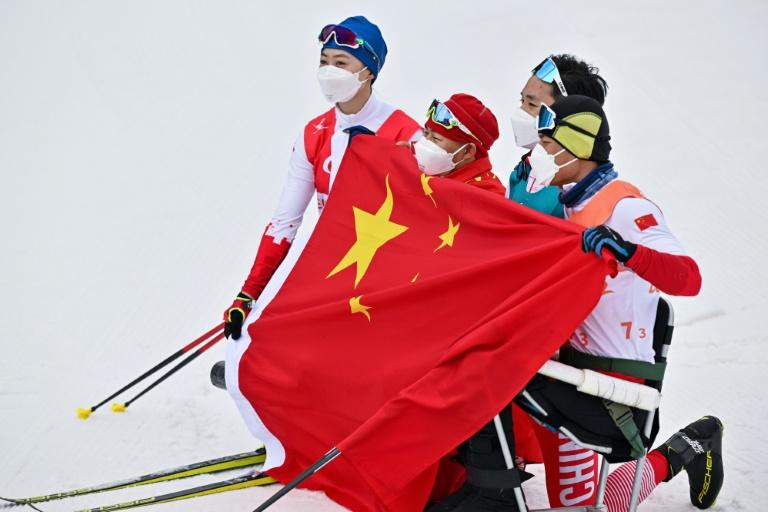
For the Chinese, the success of the Paralympic Games is without nuance. As at the Olympic Games, their health bubble remained airtight, despite a surge in COVID cases in the country. Above all, their athletes have broken the ceiling of the most optimistic ambitions in terms of performance.
In ten days of competition, the Chinese delegation won 61 medals, more than double that of Ukraine (29), ranked second in the nations table. The Chinese have won eighteen titles. Staggering.
On the Paralympic level, however, China has always been without rank. The country participated for the first time in the winter meeting in Salt Lake City in 2002. But it had to wait until the PyeongChang Games in 2018 to win its first gold medal, on the curling ice.
At the Beijing Olympic Games, two weeks earlier, China's growth spurt (3rd with 15 medals including 9 gold) was surprising, but without really going beyond belief. At the Paralympic Games, she surprised everyone, like the hat-trick achieved in men's snowboard cross, UL category (upper limbs), or the podium finish achieved by Zhang Mengqiu, five times medalist in alpine skiing.
The miracle ? Work, respond the Chinese. The Italian coach of the Chinese alpine ski team, Dario Capelli, recruited five years earlier, explains: “ For 11 months, these athletes worked tirelessly, without giving themselves the slightest respite. When I arrived in 2017, I realized that most of them were beginners. We started from zero. But the work accomplished was colossal. They invested fully. »
Money did the rest. According to Chinese media, sports authorities have spent lavishly to catch up. The preparation for the Beijing Games has been unparalleled in the still short history of the Chinese Paralympic movement. As with the Olympic disciplines, China recruited foreign coaches (a Russian coach, Nikolai Sharshukov, was poached to take charge of the hockey team). She has increased the number of courses all over the world, placing her athletes in ideal conditions, free of material and financial constraints.
At the same time, China has implemented a vast national detection plan. Just one year after obtaining the organization of the Winter Games in 2022, a Paralympic competition circuit was created from scratch to boost practice and unearth the best hopes.
Another reason for the historic performance of the Chinese delegation: competition reduced by the exclusion of Russia and Belarus. At the PyeongChang 2018 Paralympic Games, Russian athletes competed under a neutral banner, but they won 24 medals, including eight gold. They were in second place in the nation rankings. The Belarusians, for their part, had been on the podium 12 times, including four times on the highest step.
Their absence freed up places, particularly in cross-country skiing and biathlon. The Chinese took advantage of this. Andrew Parsons himself recognized this: the exclusion of the two countries has “ undoubtedly affected the results"