
Unlikely. At 13 p.m., this Tuesday, February 8 in Beijing, China was at the top of the medal rankings for the 2022 Winter Games. The host country, long singled out as a dunce in winter disciplines, had five medals, including three in gold. He was ahead of Sweden, the Russian Olympic Committee (ROC) team, the Netherlands and Germany.
Five medals including three titles less than a third away from the Beijing Games: China has already won its bet. Seven months after Tokyo 2020 and the historic Japanese performance, it demonstrates that home advantage can work miracles, even in the absence of an audience. It also proves that the considerable resources allocated by the authorities to prepare the athletes were judiciously spent.
With such a start, the lights are all green. The health situation is under control (only 6 positive cases for the day of February 7). The opening ceremony was a hit on Chinese television (316 million viewers). Temperatures are rising (7° in Beijing this Tuesday). Peng Shuai appears everywhere, at the ice rink and at the foot of the slopes, visibly delighted with her week. As for the official mascot, the panda Bing Dwen Dwen, it is already out of stock in official stores.
Cool. But the Chinese present a much less brilliant copy on one of the major issues for the success of the Games: transport. Certainly, the two Olympic trains, linking Beijing to Yanqing (26 minutes) and Zhangjiakou (50 minutes), are admired by those accredited. Luxury, comfort and pleasure. But the official bus network turned out to be a disaster. And the adventure of a journey from the capital to a ski event, whether alpine or Nordic, can turn into a nightmare.
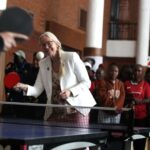
First difficulty: reaching Qinghe station in Beijing. The journey requires two successive buses from the official hotels. The shuttles are supposed to circulate without hindrance, thanks in particular to the presence of an Olympic lane on the main roads. But the reality turns out to be different. Monday February 7, the passage of a convoy of official cars taking a dignitary to the station blocked traffic for around twenty minutes. Result: several groups of accredited people missed the train to Yanqing, site of the alpine skiing events. Among them, the Swedish Petra Sörling, the new president of the International Table Tennis Federation (ITTF).
The following ? When they get off the train, a first bus takes the accredited people to a huge bus station, located in the middle of nowhere. Stopping is mandatory. Everyone gets off. A second shuttle then takes over to get closer to the mountains and the competition sites. “ It's still far away“, we ask the volunteers between glances at the clock. Answer : " About an hour, depending on traffic"
Things could end there, but the journey still has its share of surprises in store. The second shuttle is extended by a third, which drops off the lucky ones at the departure of the gondola leading to the foot of the slopes. Two buses, a train, three other shuttles, a cable car. A good three hours with optimal success, up to five hours for the unluckiest.
The return to Beijing could also turn into a disaster scenario. At the end of the day, the frequency of the shuttles goes on endlessly, until it turns into a bad joke. A shuttle every two hours, from 18 p.m., to reach the capital from the bus station. Monday February 7, a group of around twenty journalists found themselves stuck in a freezing parking lot for more than an hour and a half, waiting for a bus.
Question from one of them to a young volunteer: “ With such cold, would it be possible to wait indoors, in a room or under a tent? » Embarrassed response from the Chinese volunteer: “ No, sorry, this is not planned. » Another question to the same volunteer: “ We are quite a group, couldn't you add a bus and take us to Beijing or the train station? » The volunteer: « Wait, I'll ask my manager. » Brief phone call. Then this response: “ No. Sorry"
Last detail: the official shuttle schedules can change from one day to the next, depending on very obscure considerations. Valid on Monday, obsolete the next day.