The year 2021 will not only remain marked, in the Olympic movement, by the organization of the first Summer Games postponed for twelve months. When it comes time to take stock, one phenomenon could well overshadow everything else: the strong arrival of women at the head of national Olympic committees.
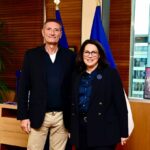
Thursday, November 11, Mexico experienced a day destined to remain engraved in history. María José Alcalá (photo above), 49, a former diver selected four times at the Summer Games between Seoul 1988 and Sydney 2000, has been elected president of the national Olympic committee. A first in the 98 years of existence of the body.
María José Alcalá's victory was clear and without nuance. At the head of a list entitled “Voy por México”, she obtained 87 votes, against 46 ballots for her rival, also female, Norma Olivia González. She will succeed Carlos Padilla Becerra, president of the Mexican Olympic committee for nine years.
The result is historic for Mexican sport, but not only in its result. For the first time, two women competed for the presidency. For the first time, also, the vote took place by secret ballot, and no longer by show of hands. The election was organized in the presence of a witness sent by the IOC, Peré Miró, the deputy director general of the body, invited by Mexican leaders to supervise the electoral process and attest to its transparency.
María José Alcalá, holder of a law degree, a master's degree in public administration and a master's degree in sports organizations, is used to electoral contests. She was elected to the Chamber of Deputies, where she chairs the sports committee.
Coincidence of the calendar: the victory of the former Mexican diver came the same week where another woman wrote the history of her country's Olympic movement. Former judoka Yael Arad, 54, the first Olympic medalist since the creation of the State of Israel (she won the silver medal in the 61 kg category at the Barcelona Games in 1992), became Sunday 7 November the first president of the Israeli National Olympic Committee. She was the only candidate vying for the top job.
This double victory of women in national Olympic committees is not anecdotal. It confirms a trend revealed in particular in France, with the success last June of Brigitte Henriques in the race for the presidency of the national Olympic and sports committee (CNOSF). Vice-president of the French Football Federation (FFF), former international player, she won in the first round of voting, with 57,87% of the votes cast, against the three other candidates: Thierry Rey (19,26% ), Emmanuelle Bonnet-Oulaldj (16,05%), and Patrice Martin (6,82%).
As in Mexico and Israel, the victory of Brigitte Henriques as president of the CNOSF was historic. The three elections confirm a strong trend in the Olympic movement: women no longer stay at the door, they try their luck. Above all, they win.
The phenomenon is not new. Two of the most powerful national Olympic committees in the world have already passed into the fold of women. Former rower Tricia Smith, member of the IOC, has chaired the Canadian Olympic Committee (COC) since 2015 and the forced resignation of Marcel Aubut, accused of sexual harassment. In the United States, Susanne Lyons has chaired the National Olympic and Paralympic Committee (USOPC) since January 2019. She succeeded Larry Probst.
Can the phenomenon depend on the thickness? Likely. The recent election to the CNOSF, where two of the four candidates were women, demonstrated that women sports leaders no longer hesitated to enter the battle. The trend will no longer reverse.
In Belgium, former table tennis player Jean-Michel Saive had to push aside a female rival, former judoka Heidi Rakels, to succeed Pierre-Olivier Beckers as president of the Olympic and Interfederal Committee (COIB).
In Germany, former fencer Claudia Bokel, former president of the IOC Athletes' Commission, is running for the position of head of the national Olympic committee (DOSB) next month. She is not given the favorite, but her victory would be part of the course of history.