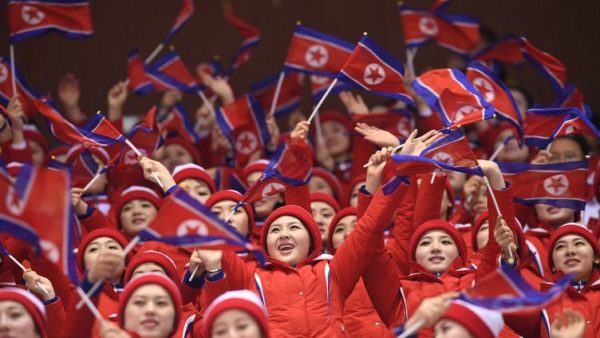
The Olympic movement will not appear in full force on Friday July 23 at the opening ceremony of the Tokyo Games. One country will be missing when the delegations parade. Less than 110 days before the event, North Korea announced on Tuesday April 6 its decision not to participate in the next Summer Games.
For the first time in history, the renunciation of a member country from the Olympic movement is not motivated by political or diplomatic reasons. It is justified on health grounds.
North Korea's Sports Ministry announced on its official website that the country had " decided not to participate in the 32e Olympic Games to protect athletes from the global health crisis caused by COVID-19"
The decision was reportedly taken on March 25 during a meeting of the North Korean Olympic committee. The official North Korean news agency, KCNA, had recounted its appearance and content. She said North Korean officials discussed several topics, including the need to invest in high technology, ways to win medals in international competitions, and finally the implementation of a five-year strategic plan. years to promote physical activity to the general public. But, curiously, she had not mentioned the decision, although historic, to give up the Tokyo Games.
Has North Korea opened a breach, by removing the Tokyo Games from its calendar for “ protect health” of its athletes? The future will answer. But one thing is certain: his absence from the Olympic event has serious consequences.
The first is political. Three years after the joint parade of the two Koreas at the opening ceremony of the PyeongChang 2018 Winter Games, the Tokyo Games could have helped bring North Korea out of its diplomatic isolation.
Moon Jae-in, the South Korean president, has made no secret of his desire to take advantage of the Tokyo Games to resume dialogue. “ This year's Tokyo Olympics could be an opportunity for dialogues between South Korea and Japan, North and South, North Korea and Japan, and North Korea and the United States », he suggested on March 1 in his speech for South Korea’s National Independence Day.
The other consequence is more directly Olympic. At the end of last week, the Seoul authorities announced that they wanted to maintain their candidacy for the Summer Games in 2032, despite the position of ultra favorite in the Australian file carried by Brisbane and Queensland. A candidacy which would be common with North Korea, structured around the two capitals, Seoul and Pyongyang.
On paper, the Korean project seemed fragile, and probably not capable of reversing a process which could designate Australia at the next IOC session, scheduled on the sidelines of the Tokyo Games. With the announcement of North Korea's withdrawal from the Tokyo Games, its chances are now almost zero.
Sportingly, the absence of North Korea should not change the course of history. But it is not anecdotal either. At the last Summer Games, in Rio de Janeiro in 2016, the North Korean delegation included 31 athletes, competing in nine sports. They won seven medals, including two gold (artistic gymnastics and weightlifting). North Korea took 34th place in the medal rankings.