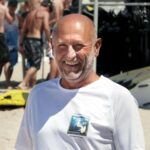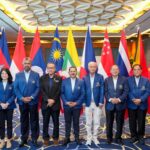

Will the battle for the 2024 Games also be that of the athletes? After Paris and Los Angeles, another candidate city has decided to entrust part of its destiny to a figure of sport and the Olympics. The German Claudia Bokel (our photo), silver medalist in epee at the Athens Games in 2004, president of the IOC Athletes' Commission, joins the Hamburg bid team. According to the German press agency SID, she was appointed president of its board of directors.
By launching head-on into the race for the 2024 Games, Claudia Bokel joins Tony Estanguet, three-time Olympic single-seater canoe champion (2000, 2004 and 2012), involved with Paris 2024, and Janet Evans, four-time gold medalist in swimming, at the Seoul Games in 1988 and Barcelona in 1992, chosen to represent Los Angeles. Budapest and Rome have not yet released their joker, but the two other cities in the running could well take their turn.
A fad? Surely not. The IOC and Thomas Bach repeat it like a refrain: the Games must be designed and organized for their primary stakeholders, the athletes. A chapter on “the Olympic experience of athletes” features prominently among the resolutions of Agenda 2020. It is supposed to constitute a criterion of choice in the Olympic candidacy process.
Between Claudia Bokel, Janet Evans and Tony Estanguet, the comparison is not easy. But let's try anyway.
Olympic past. Benefit to Janet Evans. The Californian won three Olympic titles at the Seoul Games in 1988, in the 400m, 800m and 400m medley, at just 4 years old. Four years later, she pocketed a new gold medal, in Barcelona, in the 17m, before completing her collection with silver in the 800m. Tony Estanguet cannot say the same. But the Frenchman achieved the feat of winning three Olympic titles in three different Games, in the same slalom discipline, the C400, an unrivaled performance in his sport. Claudia Bokel follows a long way away, with her silver medal in team epee at the Athens Games in 1.
International notoriety. Once again, advantage to Janet Evans. The American was one of the queens of the Seoul Games. Above all, she made a career in swimming, one of the most publicized sports on the Olympic program. Tony Estanguet, and especially Claudia Bokel, suffer from the comparison, for having chosen disciplines that are much less universal.
Role in the application. Advantage to Tony Estanguet. The Frenchman has supported the Paris Olympic project since its inception. Initially placed in position number 2 in the bid team, just behind Bernard Lapasset, he moved up a notch. He now forms with the president of World Rugby a pair inspired by the duo composed by Jean-Claude Killy and Michel Barnier for the Winter Games in Albertville in 1992. Claudia Bokel and Janet Evans cannot say the same. But the two young women also occupy very high positions. The American is vice-president of Los Angeles 2024 and responsible for athlete relations. The German will chair the board of directors of Hamburg's bid, a role which should lead her to lead international relations, particularly in the areas of culture, politics and the economy.
Influence in the Olympic movement. Advantage to Claudia Bokel. The former swordswoman chairs the IOC Athletes’ Commission. Elected to this position in 2012, she was extended during the IOC session at the Sochi Games in 2014. As such, she sits on the Executive Board, a privileged position. Her commitment to the German candidacy prompted her, last August, to resign from the IOC Ethics Commission, but she continues to chair the steering committee of the athlete career monitoring program. Tony Estanguet is also a member of the IOC. But the Frenchman joined at the end of 2012, four years after the German. In Lausanne, he is said to be very popular within the institution, as proof of his presence in four of its commissions, including that of Olympic Solidarity. Janet Evans is not a member of the IOC. Its influence in the Olympic movement remains, to date, quite limited.