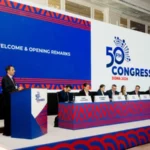
Thomas Bach, the president of the IOC, explained it Thursday afternoon, at the end of a two-day session of the executive board: the bidding process for the Winter and Summer Games should be modified. A recommendation will be made to this effect at the General Assembly of the Olympic institution on December 8 and 9 in Monaco. Unless there is a huge surprise, it will be voted on and validated. The new process could gain in flexibility and clarity. It could be less restrictive and less costly for requesting cities. Thomas Bach spoke of the idea of an “invitation” to them to enter the race. An entire program.
But does it really matter? Obviously, the IOC believes this without nuance. But not all the actors in the Olympic movement seem to be of the same opinion. Lars Haue-Pedersen, the executive director of TSE Consulting, an international company specializing in advising cities, regions, and countries on their approach to sport and sporting events, puts forward a different point of view. He explains, for FrancsJeux, the main lines.
“In recent months, many experts, reporters, and opinion leaders in the world of sport have debated the issue of how the IOC can continue to maintain the interest of the world's cities in its main product: the Olympic Games . Discussions so far have focused on adjustments the IOC can make to simplify the bidding process, on the assumption that this change could boost interest among cities to bid for the Games.
While everyone seems to be looking for the best solution, we should perhaps ask ourselves whether the current debate has been viewed from the wrong angle. Because this assumption could turn out to be fundamentally wrong and could therefore steer the debate in the wrong direction for the IOC.
When in a city, a region or a country, responsible elected officials and politicians evaluate the opportunity to stand as candidates, they focus only on weighing the pros and cons of organizing the Games rather than on the candidacy process. himself. Very few cities learn about the application process before thinking about applying for a future Olympiad. The elements that are studied first are, mainly, costs, infrastructure needs, and other such topics related to the Games themselves.
While these issues play a vital role in the decision to pursue an application, the application process itself is relatively unimportant. If a city is willing to invest 10 billion in a project, they can certainly spend 10 million to get things done correctly at the time of application.
The bidding process should be seen for what it really is: a bidding process that would allow the IOC to ensure it is “buying” the best potential city. The process should not be seen as a tool to “sell” the Olympic Games to cities.
To stimulate interest from potential cities, the IOC should direct its attention to the product that cities are buying: the Olympics. This task can be accomplished by explaining to cities that we cannot necessarily reduce costs (we are all willing to pay more for greater value), but that this event can be part of a long-term strategy that has to meaning for the city and its inhabitants.
As all cities are different, with specific objectives, the short-term project (the Games themselves) must be flexible so that it can integrate with and reinforce the long-term strategy of the end client – the host city.
The solution for the IOC and other rights holders is to ensure that the most attractive and creative cities want to host the Olympic Games. Focusing only on the simple process of selecting them could prove to be a mistake.”