Photo credit: CNOSF / KMSP
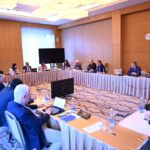
France is not yet a candidate for the Olympic Games. Maybe she will be. Or maybe not. But it took several steps forward, Thursday April 4, with the very official launch of the French International Sports Committee (CFSI). The event took place at the CNOSF headquarters in Paris early in the morning. In detail, it was nothing more than a working meeting, the first since the decision last December by the Minister of Sports, Valérie Fourneyron, to transfer responsibility for international relations from the State to the sports movement. . But this meeting, attended by around twenty people, delivered the three blows of a French presence announced to be more visible and aggressive on the world stage.
In terms of form, nothing very spectacular. The CSFI is an office tenant at the CNOSF headquarters. It has a budget of €500, enough to exist, but certainly not to be heard on all grounds. “We will establish priorities,” assured Valérie Fourneyron. “During its next General Assembly, the CNOSF will decide on an additional allocation which could be interesting,” promised Denis Masseglia, the president of the National Olympic Committee.
The CFSI must meet every three months. This is little. Its composition turns out to be a very broad mix, to the point of appearing confused, of the French members of the IOC, Guy Drut and Jean-Claude Killy, the Minister of Sports, the president of the CNOSF, his alter ego from the Paralympic committee, Gérard Masson, seven representatives from the sports movement, as many from the State, five from local authorities and three from the economic world. Its president is Bernard Lapasset, also head of the IRB, the International Rugby Federation. Tony Estanguet, the three-time Olympic kayak champion, recently retired, will be its ambassador.
The rest also turns out to be quite classic. Bernard Lapasset announced the “first five decisions” of the new armed wing of French sports foreign policy: the sending next week of a letter to all national sports federations calling on them to express their expectations and their international projects, the establishment of a network of relays and informants abroad, in order to constitute a “watch”, the establishment of an international cooperation strategy, the constitution of a group of international ambassadors, for the majority of former athletes, and finally the participation of French representatives (federations, companies, etc.) in major events abroad.
A very “basic” approach that Bernard Lapasset summarizes: “We had the will and the skills, but we lacked a way to organize everything. We are moving in the right direction. Competition is strong, with all emerging countries. But we are giving ourselves the means to meet the challenge, to find a France that is winning. » Tony Estanguet says, for his part, “very motivated” by the project, but he admits “now waiting for the words and intentions to be quickly followed by concrete actions. " He is not the only one.
There remains an unknown factor, a question on everyone's lips: will we see a French candidacy for the 2024 Summer Games? Bernard Lapasset responds… without answering: “It’s everyone’s ambition. If we feel the window opening, we will go. But the decision will depend on several factors, including the choice of host city for the 2020 Games, and the identity of the next IOC president. » Nothing is done, therefore. And everything has to be done.